
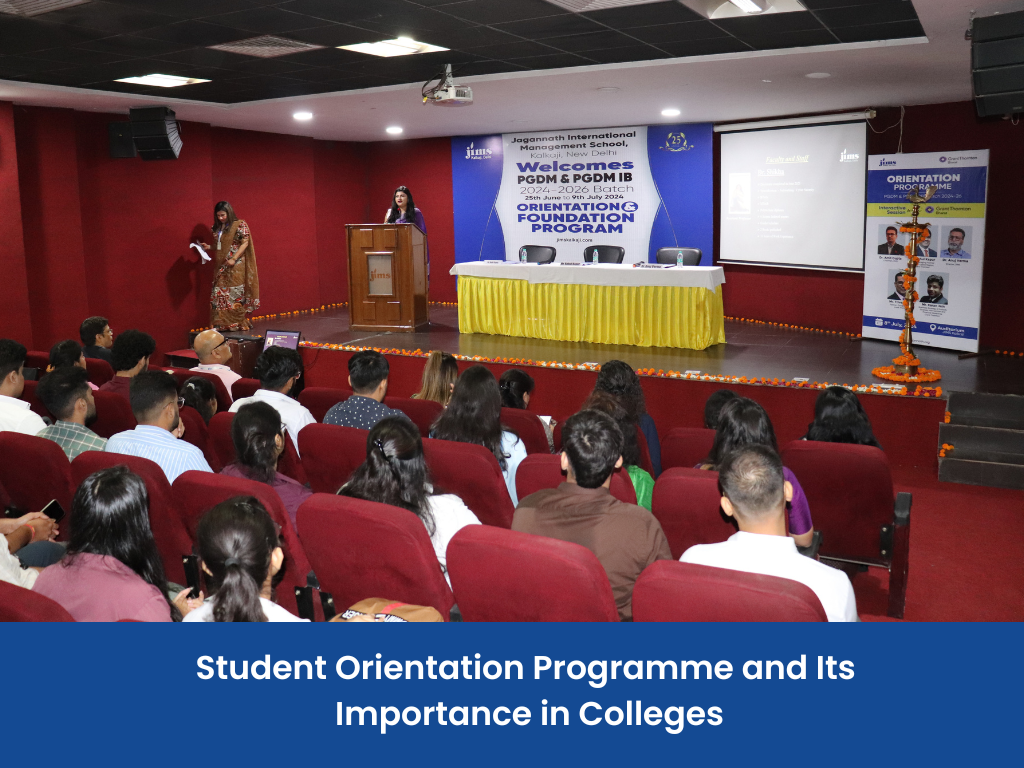
Walking into a new college campus for the first time comes with a familiar rush of questions. Where is my classroom? Who are my professors? How do I make friends in a place where I know no one? A student orientation programme exists to answer exactly these questions — and to do it before students even have to ask.
At its core, an orientation programme is the structured process through which a college introduces new students to its academics, culture, people, and expectations. Done well, it becomes far more than a welcome event — it becomes the foundation on which a student’s entire college journey is built. At JIMS Kalkaji, this philosophy shapes every element of what is formally known as the Foundation & Orientation Programme, run for PGDM and PGDM (International Business) students at the start of each academic year.
This article breaks down what orientation really means, why it matters so much in the first weeks of college, and how JIMS Kalkaji’s approach to it gives students a genuine head start.
What Does “Orientation Programme” Mean?
An orientation programme is a planned set of sessions and activities — typically spread across one or more days at the start of an academic term — designed to help new students settle into college life. It covers three broad areas:
- Academic orientation – understanding the course structure, faculty, evaluation pattern, and what the programme demands.
- Social and cultural orientation – learning about clubs, events, campus norms, and how to build a peer network.
- Institutional orientation — meeting the people who run the institution, from the chairman and director to programme coordinators, so students know exactly who to approach for what.
Rather than leaving students to figure all this out on their own over weeks or months, orientation compresses that learning curve into a focused, guided experience right at the start.
Why Orientation Programmes Matter in College
1. They Ease the Transition Into a New Environment
For many students, especially those moving cities for their PGDM or undergraduate degree, college is the first extended stretch away from home. An orientation programme gives them a structured, low-pressure way to get their bearings — from locating classrooms and the library to understanding attendance rules and grading systems — instead of learning it all through trial and error in the first stressful month.
2. They Build Peer Networks From Day One
Some of the strongest friendships and professional networks of a person’s life begin in the first week of college. Orientation activities — icebreakers, team introductions, group tasks — are deliberately designed to get batchmates talking to each other quickly, so students don’t spend their first weeks feeling isolated in a large, unfamiliar batch.
3. They Set Academic and Professional Expectations Early
A good orientation doesn’t just say “welcome” — it tells students plainly what lies ahead: the rigour of the coursework, the skills the programme will build, and what recruiters or higher studies will eventually expect of them. This early clarity helps students calibrate their effort from week one rather than realising the stakes only near placements or exams.
4. They Connect Students to Faculty and Leadership
Orientation is often the only time in the year when the entire institution — chairperson, director, faculty, and support staff — is present together to welcome a new batch. That visibility matters. When students see senior leadership personally invest time in them on day one, it builds trust and a sense that the institution is genuinely invested in their success, not just their admission.
5. They Reduce Early Dropout and Disengagement
Students who feel disconnected in their first month are far more likely to disengage — skipping classes, avoiding clubs, and struggling silently. A well-run orientation directly counters this by making students feel like they belong to a community from day one, which research on student retention consistently links to better attendance and persistence through the course.
How JIMS Kalkaji’s Foundation & Orientation Programme Stands Apart
Orientation isn’t treated as a single welcome assembly — it’s run as a multi-day Foundation & Orientation Programme, reflecting the institute’s belief that the first days on campus shape the next two (or three) years.
- A leadership-first welcome
The programme typically opens with a traditional Lamp Lighting Ceremony, followed by addresses from Chairman Dr. Amit Gupta and the Director, who speak directly to incoming students about what the institute expects from them — and what they can expect in return. Recent PGDM batches, for instance, have been introduced to a framework built around Competence, Confidence, Communication, and Curiosity — a lens students are encouraged to carry through their two years at JIMS.
- Real interaction with industry, not just academics
JIMS brings in corporate leaders and alumni — from senior managers at consulting and FMCG firms to founders and Babson-educated entrepreneurs — to speak with incoming students in their very first week. This gives students an early, honest picture of the corporate world they’re preparing to enter, well before placement season arrives.
- Career-readiness built into orientation itself
Unlike a purely ceremonial welcome, JIMS orientation includes practical sessions on interview skills, mock group discussions, general knowledge, and how to add value during internships — alongside sessions on time management and stress management. Students leave orientation week with real tools, not just information.
- Introduction to campus life beyond the classroom
New batches are introduced to JIMS Kalkaji’s clubs — the Cultural Club, Sports Club, and NSS Club — along with campus facilities such as the Incubation Centre, and sports infrastructure including a Badminton & Pickleball Court and a Netted Cricket Zone. For undergraduate students, orientation culminates in a lively Freshers’ welcome, complete with performances and titles like Mr. and Miss Fresher — a light-hearted way of cementing new friendships right at the start.
- A two-day structure for depth over speed
Rather than compressing everything into a single rushed day, JIMS Kalkaji spreads its PGDM and PGDM (IB) orientation across two days — covering institutional values, industry exposure, and skill-building sessions separately, so students absorb each part properly instead of being overwhelmed in one sitting.
The Real Purpose: A Head Start, Not Just a Welcome
The goal of orientation isn’t simply to make new students feel comfortable for a day — it’s to give them a running start. A student who leaves orientation week knowing their faculty, their peers, their campus, and what’s expected of them is a student who spends less time adjusting and more time actually learning, building, and growing.
That’s the philosophy behind JIMS Kalkaji’s Foundation & Orientation Programme: treat the first days on campus not as a formality, but as the first real investment in a student’s academic and professional journey.
Frequently Asked Questions
Q1) What is the meaning of a student orientation programme?
It is a structured induction process, usually held at the start of an academic session, that introduces new students to a college’s academics, faculty, campus, and culture so they can transition smoothly into college life.
Q2) Why is orientation important in the first year of college?
It reduces the stress of adjusting to a new environment, helps students build a peer network early, clarifies academic and professional expectations, and connects them directly with faculty and leadership.
Q3) How long does JIMS Kalkaji’s orientation programme run?
JIMS Kalkaji, the best MBA college in Delhi runs a multi-day Foundation & Orientation Programme for its PGDM and PGDM (IB) batches, along with a dedicated Orientation Ceremony, each combining institutional briefings, industry interaction, and skill-building sessions.
Q4) Who addresses students during JIMS Kalkaji’s orientation?
Students are addressed by the Chairman and Director of JIMS, along with faculty, programme coordinators, and invited industry leaders and alumni who share real-world professional insights.
